Home / Products / Folding-Arm Awnings
Shade that folds away before the pass sends a gust down to take it
Retractable folding-arm awnings for Wellington stoeps, cellar terraces and wine-estate function spaces — specified with the Bain's Kloof wind funnel in mind from the first conversation, not as an afterthought.
The wind is the first question, not the fabric colour
Anywhere else, an awning conversation usually starts with fabric and projection. In Wellington it starts with wind. Bain's Kloof funnels genuine mountain gusts down into the valley, and an awning caught fully open in that kind of gust is a write-off, not an inconvenience. Every awning we fit here gets a real wind rating matched to its position, and on anything exposed — a wine-estate terrace, a stoep with a clear run down the valley — we specify a motor with a wind sensor as standard, not an upsell, so the fabric retracts itself before the gust arrives rather than after the damage is done.
No posts, no interrupted vineyard view
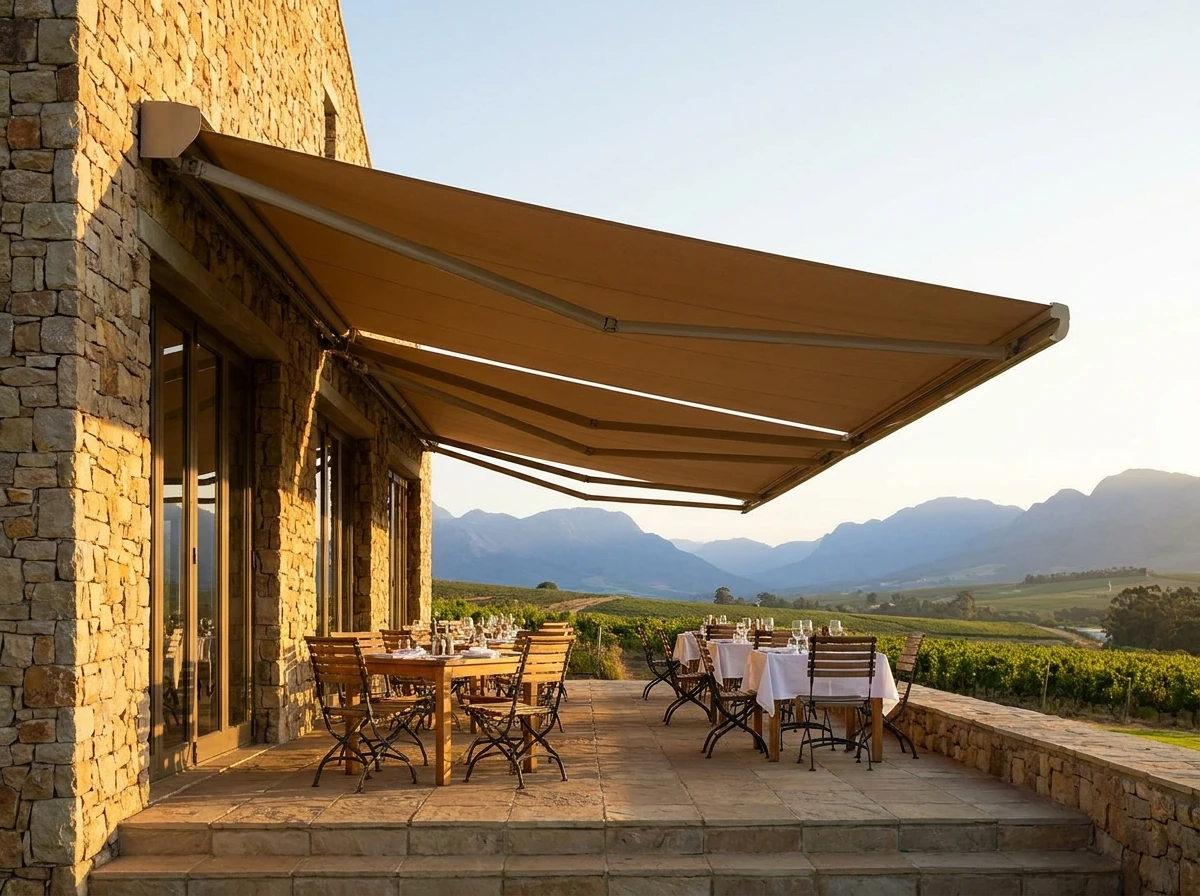
Folding-arm awnings project on spring-tensioned arms with no ground posts — which matters on a stoep or terrace built to look straight down a row of vines, where a post in the middle of that view would defeat the point. Full cassette housings (fabric and arms sealed away completely) suit exposed wine-estate positions best; semi-cassette or open mounting works on more sheltered stoeps.
The seasonal argument, and why it fits a working valley
A folding-arm awning shades a harvest-season lunch on a stone stoep and then retracts to let the low winter sun back in — a fixed roof structure can't make that trade. On a working wine estate that hosts both, that flexibility is worth more than a permanent structure that shades the same table twelve months a year whether it's wanted or not.
We don't quote an awning for Wellington without first asking how exposed the position is to the pass — the fabric colour is the easy part of that conversation.
On-site measure, WellingtonHonest limitation: an awning is a shade product, not a rain product — fine at a pitch in light drizzle, never intended for storm rain or standing water. Fixing substrate (stone, brick, timber) needs a site assessment before any quote is final.
What an awning costs over a Wellington stoep
Cost is set against projection, meaning the ground area covered with the arms extended, and the figure includes installation. Crank-operated, R3,500 through R5,500 for every square metre, with an open or half-cassette in a sheltered spot at the lower figure, a full cassette out on an unprotected one at the upper. Motorised and wind-sensored, the same awning is R5,500 to R7,500 for each square metre it covers.
With wind coming straight down off the mountain, the motor and the sensor are worth more than another metre of fabric, because an awning that pulls itself in as the wind rises is the one still there in a few years. A short awning above a door meets a minimum, and the fabric of the wall behind the fixings shifts — old brick, thick plaster, a timber beam — changes the figure as well. The free site assessment settles that, and the written quote afterwards carries your real price.
- Full cassette, semi-cassette or open mounting
- Motorised with wind-sensor auto-retract, specified as standard here
- Solution-dyed acrylic fabric, holds colour under Cape UV
- Projection to roughly 3-4m class over wide stoeps and terraces
- Site-assessed fixing on stone, brick or timber substrates
Got a stoep or terrace that needs real shade?
We measure at the house for free, quote in writing per opening, and leave you to decide.