FREE GUIDE — WELLINGTON, BOVLEI VALLEY, WESTERN CAPE
Wind first, then light.
Nearly every guide to blinds starts in the lounge with a fabric swatch. In Wellington the swatch is the last decision, not the first. This valley hands you its conditions in a fixed order — a wind that comes down the kloof with a mountain range steering it, a late sun that swings round past west as it drops and slips under every overhang you own, and a housing stock with walls half a metre thick and openings that stopped being square a century ago. Work from the mountain inwards and the specification writes itself. Work outwards from the swatch and you will be refitting something after two summers. Here is the order we work in, and why.
Wellington lies on the floor of the Bovlei with the Hawequas rising immediately behind it and the mouth of Bain's Kloof at its shoulder — the old wagonmaker's valley, Wagenmakersvallei, with the Berg River running out of it to the north.1 The pass road above the town was cut by Andrew Geddes Bain and opened in 1853.2 It is a lovely drive. It is also, in a very literal sense, the shape of your window problem.
A kloof is a narrowing, and air forced toward a narrowing has to speed up to get through it. The Cape's dominant summer wind runs from roughly October through March,3 and here it has a whole mountain range steering it. What lands on a Wellington stoep on a hot February afternoon is not a suburban breeze that happens to be blowing hard. It is valley air with somewhere to be.
The consequence is blunt and it decides half of what follows: anything fitted outside the glass in this valley is a structural decision, not a decorative one. An awning that would last a decade in a sheltered city garden can be folded in a single gust here if the frame, the fixings and the retraction logic were chosen off a picture rather than off a wind rating.
Three questions worth asking of anything mounted outdoors
What wind class is the frame rated to, in writing? Not "it's a heavy-duty model" — an actual rating on the quotation, with the fabric and the frame considered together.
Does the motor carry a wind sensor, and does it retract or just stop? A sensor that closes the unit before a gust arrives protects far more than extra fabric weight ever will. On an exposed elevation we would rather quote a smaller motorised unit with a sensor than a large manual one.
What is it actually fixed into? On old stonework and soft lime plaster, the anchor matters more than the bracket. Chemical anchors into sound masonry — never expansion plugs driven into crumbling render and hoped for.
The observation to make before you enquire
Stand where you want the shade, at about four in the afternoon, on three separate hot days in January or February. Note which way the poplars and the vine rows are leaning and how hard, and whether your stoep sits on the exposed side of the house or in its lee. Two minutes of that beats an hour of catalogue reading, and it is the first thing our consultant will ask you about.
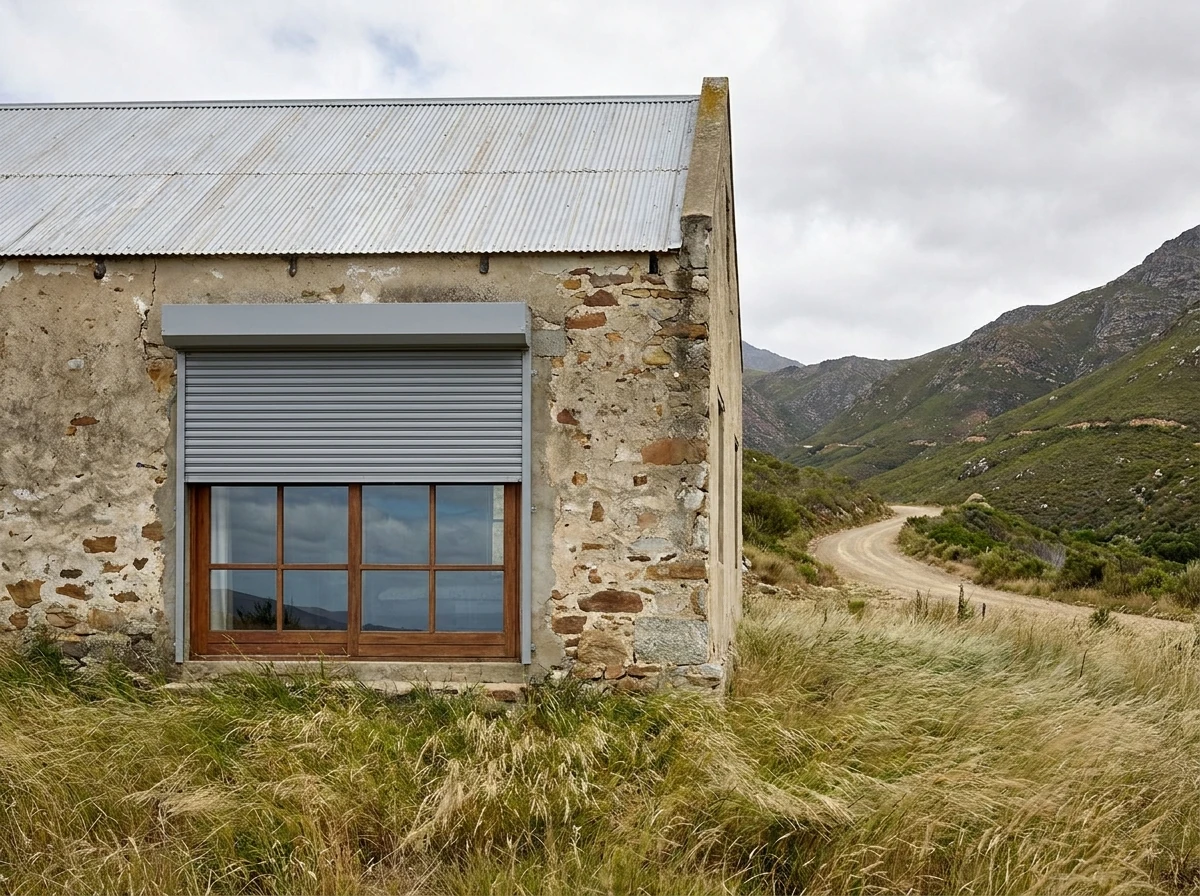
Rigid slats, a headbox anchored into stone, and a pass road climbing away behind. Exposure like this is a hardware question long before it is a fabric question.Two · the wall
Why the good answer here sits outside the glass
There is one piece of physics behind every heat complaint we are called out to. Sunlight passes through window glass as short-wave radiation. It lands on your floor tiles, your leather sofa, your dark kitchen counter, and those surfaces absorb it and re-radiate it as long-wave heat — which the same pane of glass will not let back out nearly as easily as it let the light in. The room fills up.
Now put a blind on the inside. It is behind the glass. It can cut glare beautifully, it can protect fabric and timber from fading, and it can do a lot for privacy — all real benefits, and most Wellington houses need them. What it cannot do is un-admit the energy that has already crossed the pane. Put the same shade outside the glass and the sun never gets in at all.
An internal blind manages the light that has already arrived. An external one decides whether it arrives.
The distinction that settles most heat enquiries
The arithmetic that catches Wellington rooms out
Wellington sits at roughly 33.6 degrees south. Two things follow from that latitude, and they pull in opposite directions.
At midsummer noon the sun here stands close to 80 degrees above the horizon — very nearly overhead. A modest eave, a stoep roof or a deep reveal will shade a wall comfortably at midday, which is why so many old farmhouses feel well-behaved at lunchtime. But it does not stay up there. Three hours past solar noon it has swung round to about due west and dropped to under 50 degrees; in the last two hours of daylight it falls below 25 degrees and keeps swinging, setting on a bearing near 241 degrees — well to the south of due west. That is the stretch that hurts: sun arriving almost horizontally at west and south-west glazing, sliding underneath every overhang on the building. That arithmetic is ours, worked from the latitude rather than measured; check it against a sun-path calculator for your own street address and you will not be far off.4
So the late-afternoon problem is not a roof problem. It is a wall problem, and it has to be met at the wall. That is why the external range is our premium tier in this valley rather than an upsell:
External venetian blinds — adjustable aluminium blades outside the glazing. Angle them and you keep your view and most of your daylight while cutting the direct beam out entirely. On a west or south-west gable with a view worth keeping, nothing else does both jobs at once.
Roller shutters — rigid aluminium slats rolling down from a headbox, giving you the full range from open glass to a completely darkened, quieted room. On this site "roller shutters" always means external shading for sun, heat and glare; security-rated products are a heavier, separate thing and we will say so plainly if that is what you actually want.
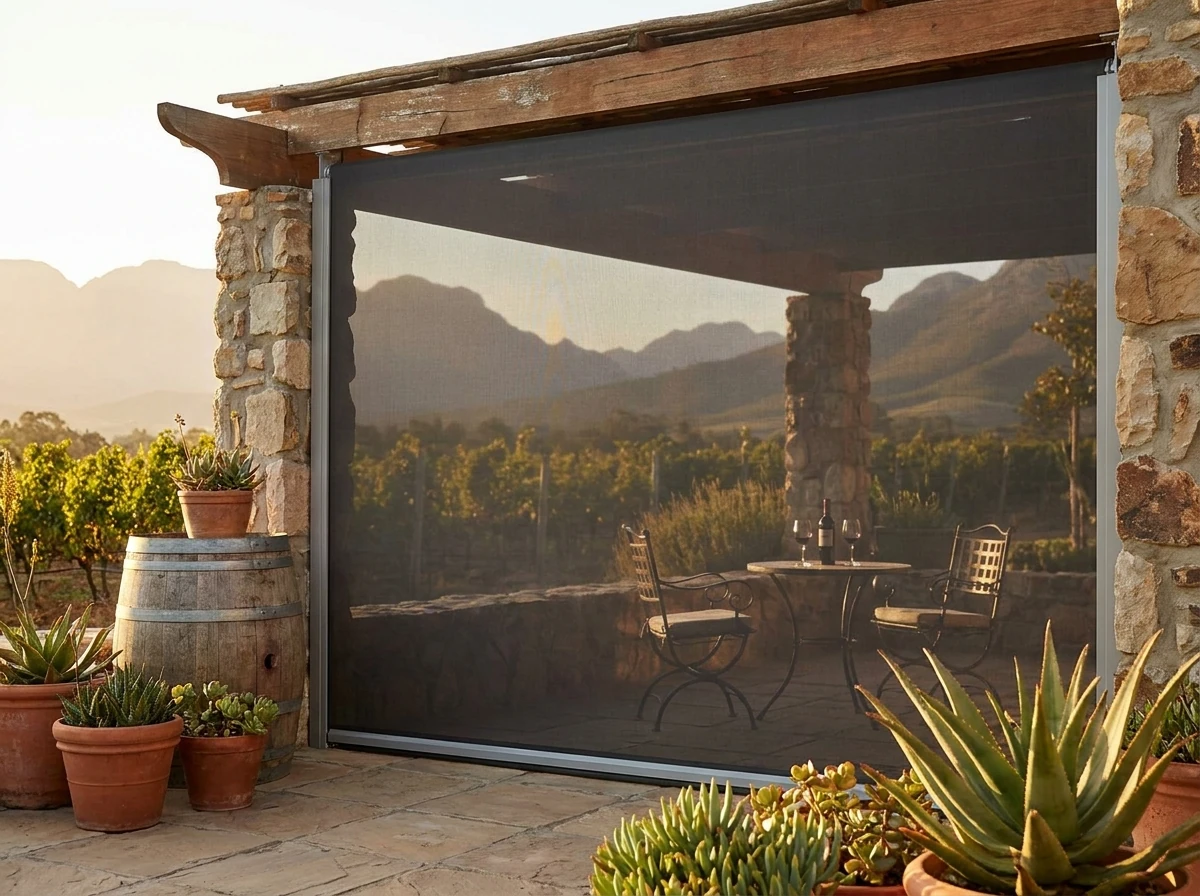
Zip screens — fabric running in fixed side tracks, so a gust cannot lift it out or belly it. In a wind valley, the tracks are the whole point.
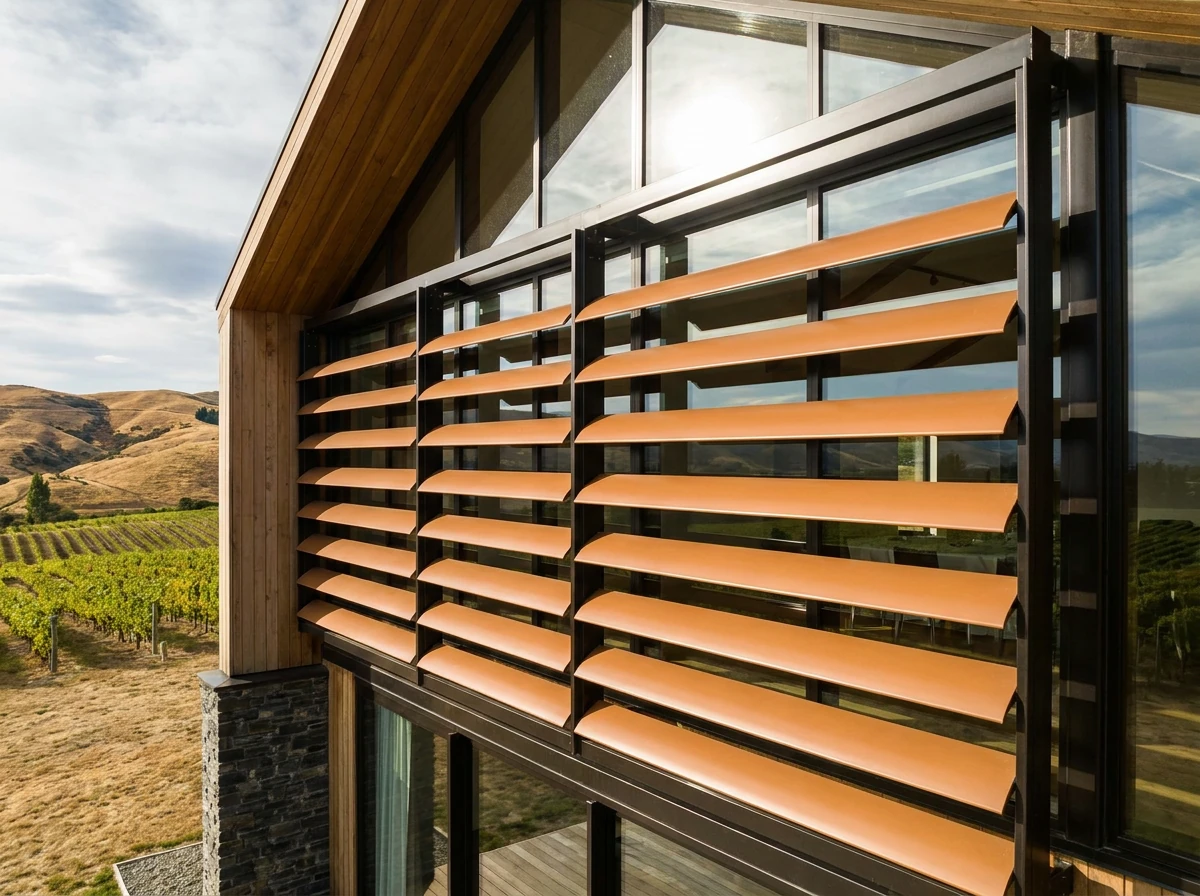
Blades outside the glazing, tilted against a low sun on a tall gable — the elevation that most often defeats an overhang.Three · the reveal
Old joinery, thick walls and the sixty-year rule
Wellington is a working town, not a museum, and its windows show it. On one road you will find a Cape Dutch farmstead with multi-paned timber sashes set into walls thick enough to sit in; on the next, a Victorian townhouse with tall narrow openings; then a plain 1960s town house with square aluminium frames; then a new smallholding build with a four-metre sliding stack facing the vines. Four completely different fitting problems inside one postcode.
Measuring an opening that has stopped being square
A century of settling does things to a reveal. Measure the width at the top, the middle and the bottom, and the height on both sides and down the centre, then work to the smallest figures for an inside fit. On an old farmhouse it is common to find twenty millimetres of difference top to bottom, and a blind cut to the widest measurement will simply not come down.
Depth decides everything else
Before anything is chosen, we measure how deep the reveal actually is, because that dictates whether a blind can live inside the opening at all. A sash that slides up, a stay bar, a window handle or an old security grille all take up depth that a bracket then cannot have. Where the depth is not there, the honest answer is a face fix onto the wall above — which looks deliberate if it is done properly and awkward if it is done as an afterthought.
The sixty-year rule, in plain language
South Africa's National Heritage Resources Act says that no structure — or part of a structure — older than sixty years may be altered or demolished without a permit from the provincial heritage resources authority.5 Wellington has a great deal of stock that clears sixty years comfortably.
What that means in practice, in our experience of fitting here: mounting a blind inside an existing reveal, with brackets into the plaster or masonry, is not normally an alteration of the structure. Cutting a new recess into an old facade, or bolting an external shading box to a protected elevation, can be. If your house is older than sixty years and you want anything visible on the outside face, ask Heritage Western Cape before you order rather than after. It costs an email, and it is a great deal cheaper than an enforcement conversation. We will tell you at the measure if we think your job is in that territory — but we are blind fitters, not heritage consultants, and we will not pretend otherwise.
Practically, on old buildings we fix into sound masonry above the opening wherever we can, and we do not screw a modern bracket through a hundred-and-fifty-year-old sash to save an hour.
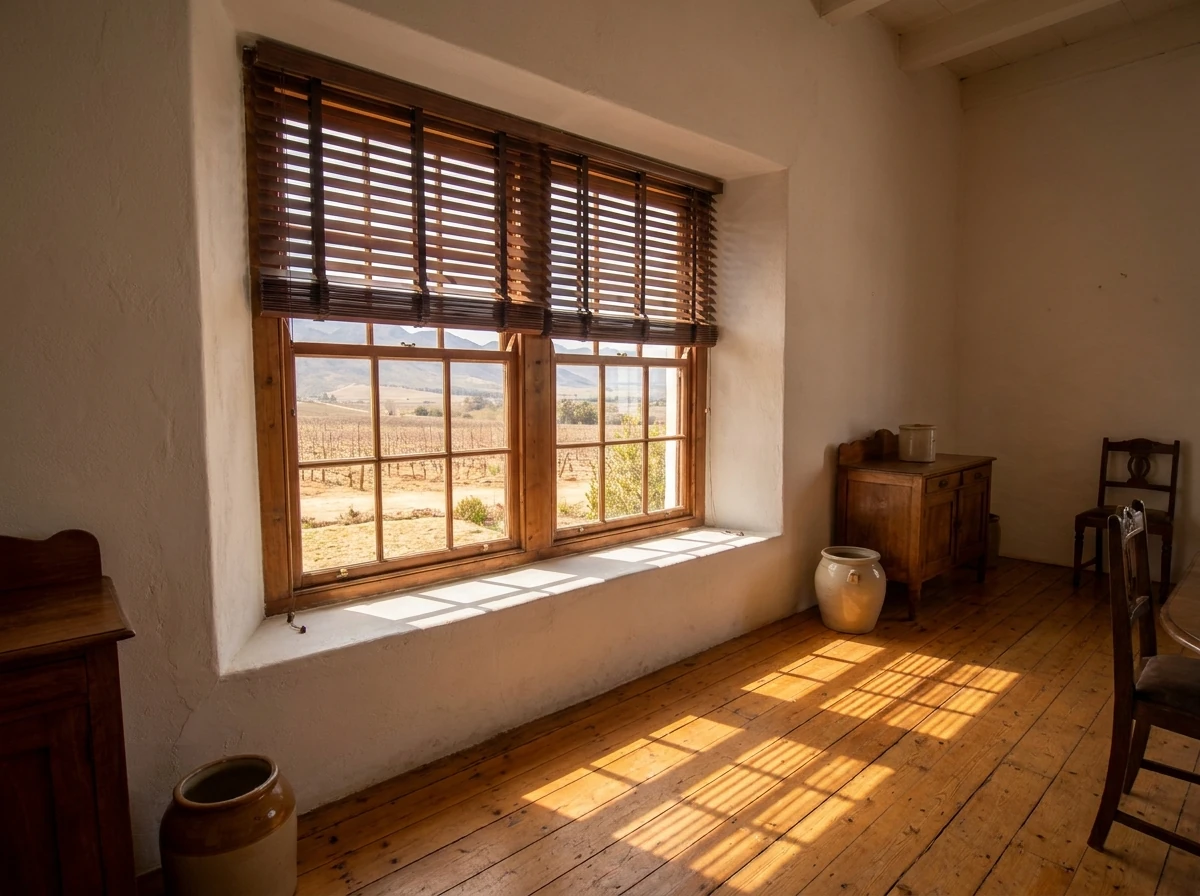
A deep-set multi-pane timber opening with slats tilted over the upper half. The grid of light on the floor is the giveaway: this is late sun coming in flat, not overhead sun.Four · the room
Choosing fabric once the hard work is done
Only now does the sample book come out, and by this point most of the choice has already been narrowed for you by the wall and the reveal. A few things are worth knowing before a consultant arrives, because they are where money gets wasted.
Openness factor is the number that matters on a sunscreen
Sunscreen mesh is sold by how open the weave is — commonly around one, three, five or ten per cent. The lower the figure, the tighter the weave, the more glare it stops and the less of the view it gives back. On a west-facing Wellington window a tight weave keeps the vineyard visible while killing most of the flare; a very open weave looks lovely in a showroom and does almost nothing at five in the afternoon. Ask for the openness figure by number, not by adjective.
Blockout does not mean blackout on its own
A blockout fabric stops light through the cloth. It does not stop light around the edges, and in a wide reveal that halo can be enough to wake you at first light in December. Genuine darkness needs the fabric to run past the opening, or side channels, or a double-roller arrangement — which is a specification decision, not a fabric upgrade, and it is much cheaper to make before manufacture than after.
The backing does the heat work; the face does the room
A dark fabric feels as though it ought to be better at heat, and inside the room it is often worse — it absorbs the energy and then radiates it at you. A light-coloured or reflective backing turns more of it around before it becomes room heat. So choose the backing for performance and the face for how the room should feel, and do not assume one colour has to do both.
Timber slats want dry air
Wide timber slats look right in a farmhouse living room or a study and we fit a great many of them here. What they do not enjoy is a steamy bathroom or a cellar wall that sweats. In wet rooms, aluminium slats or a suitable synthetic will still look correct in ten years' time; timber in the wrong room warps, and no adjustment fixes it afterwards.
Five · the night
A valley that gets genuinely cold
Summer heat is what people enquire about. Winter is what they complain about afterwards. Wellington sits in a winter-rainfall region with real mountains around it, and the same thick walls that make a farmhouse pleasant in February give their warmth back slowly in July. After dark, the coldest surface in almost any older room here is the inside face of a single pane of glass — and heat leaves through it all night.
That is where cellular honeycomb blinds earn their place. The insulation is not the fabric; it is the layer of still air trapped inside the cells. Which means the fit matters more than the specification. A honeycomb blind hung loose with a forty-millimetre gap down each side lets a convection current run happily around it and is, thermally, a decoration. Fitted snugly into the reveal, or in side channels where the reveal allows, the same blind is doing the job you paid for.
What a blind can and cannot do about condensation
Water appears on the inside of your glass when the moist air in the room touches a surface cold enough to drop it below dew point. There are only three levers: make the glass warmer, make the air drier, or move the air. A well-fitted blind helps with the first. It does nothing for the second and, if it is sealed tight against a cold pane in a room with no ventilation, it can make matters worse by creating a still, damp pocket where mould is happy. In bathrooms and kitchens, ventilation comes first and the blind second — we will say so at the measure even though it is not the answer that sells the most fabric.
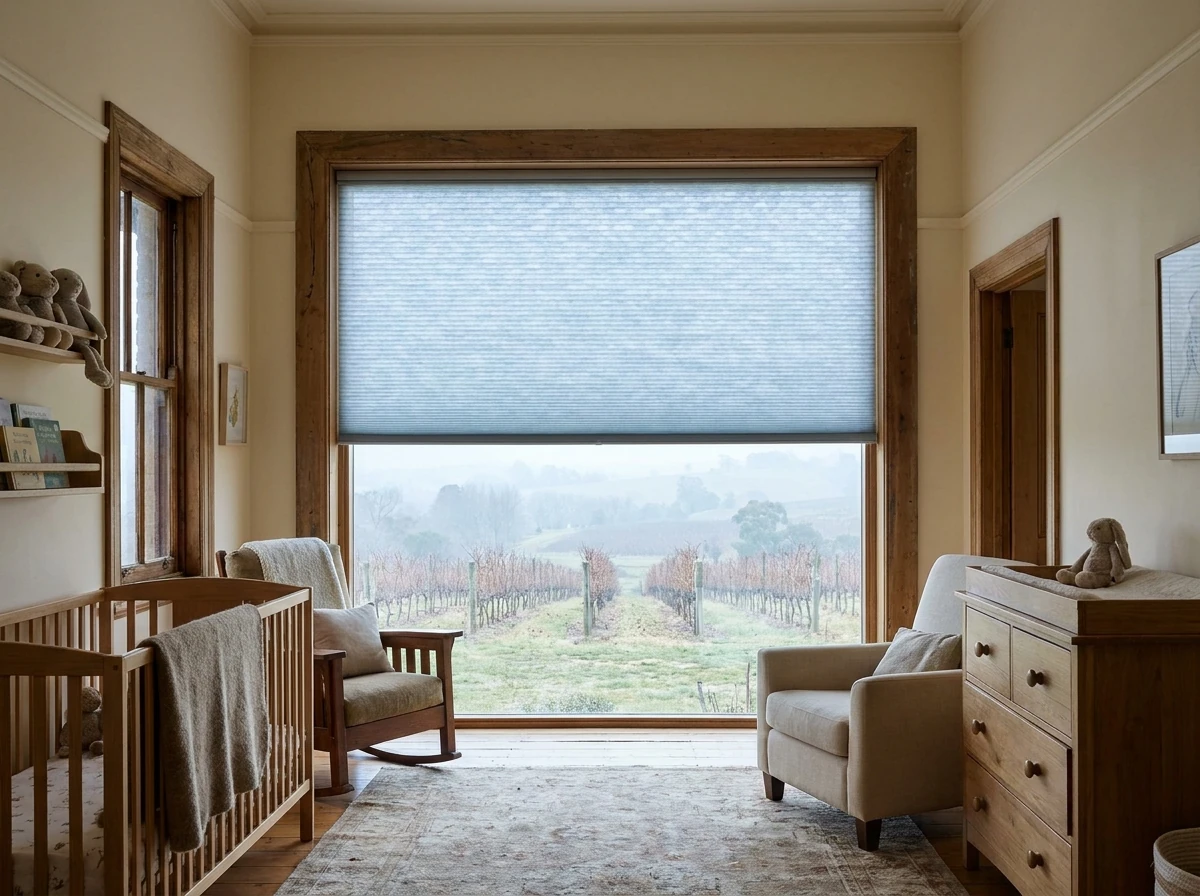
Honeycomb cells over a tall farmhouse opening, with winter mist sitting on the vine rows outside. In a room that has to stay warm overnight, the side gaps matter as much as the fabric.Six · past the wall
The stoep, the terrace and the cellar door
A great many Wellington enquiries are not really about a window at all. They are about a stoep that is unusable between two and six, a terrace beside a cellar that has to work for a lunch in a gusty north-wester, or a covered patio that gets rained into sideways in June.
Two products carry most of that work, and they answer to different problems.
Folding-arm awnings give you a large area of shade with nothing standing in the middle of it — no posts, no frame in your sightline — and they fold away entirely when you want the sun back in September. The trade-off is that a folding-arm unit is, by design, a sail. In this valley that makes automatic retraction non-negotiable rather than a luxury: the sensor must bring the arms in before a gust reaches them, not after the fabric has already taken it.
Zip screens solve the other half. Because the fabric runs in fixed tracks down both sides, the wind cannot get under an edge and lift it, which turns a covered terrace into something close to an extra room — shaded, sheltered from driven rain, and still open to the view through the weave. On a west-facing terrace they also block low sun that no roof overhang can reach.
The honest limitation on both: neither is a wall. A zip screen will hold off wind-driven drizzle and take the sting out of a hot afternoon. In a genuine winter storm coming straight down the kloof, you go inside, and any supplier who tells you otherwise is selling you something.
Tracked fabric closing the open side of a cellar terrace. The view survives the weave; the wind does not get under the hem.Seven · on site
The eight things only a site visit can answer
Everything above can be read at a kitchen table. None of it settles the quotation, because a window is a physical object in a specific wall on a specific elevation. This is the list a consultant works through at your free measure, and it is why we do not publish prices.
Which elevation each opening actually faces. A compass reading per window, because "the sunny side" and "west" are not always the same thing once a house has been added onto twice.
How exposed that elevation is to the kloof. Two houses on the same street can have completely different wind lives depending on what stands upwind of them.
Reveal depth, at every opening. The number that decides inside fit against face fix, and whether a headbox will clear the handle.
How far out of square the opening has gone. Measured at three points each way, worked to the smallest.
What the fixings are going into. Sound brick, old stone, soft lime plaster, timber lining or aluminium frame — four different anchors, and getting it wrong is how brackets pull out.
The age of the building. If it is over sixty years old and anything is going on the outside face, that changes the conversation before it changes the quote.5
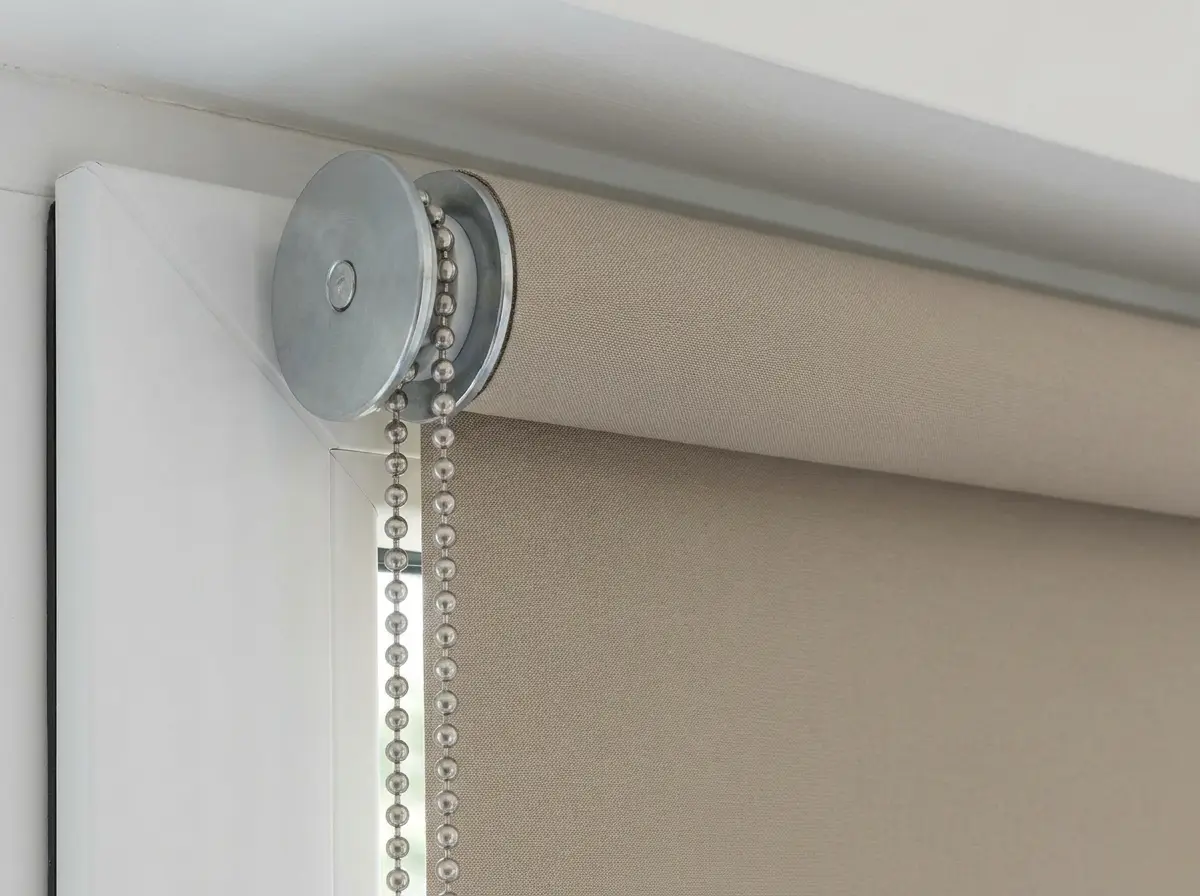
Who uses the room. Every corded or chained blind we fit gets a tensioner as standard; in nurseries and children's rooms we will normally steer you to cordless, wand-tilt or motorised operation instead, and that is built into the quote rather than added later.
Where the power and the signal can go. Motorisation is straightforward in a new build and a genuine puzzle in a solid-wall farmhouse. Battery, hard-wired or solar are all options; which one is sensible depends on the wall in front of us.
The control side of a fitted roller. Small decisions — tensioner, chain side, bracket type — get made standing in the room, not on a spreadsheet.
If you have read this far, you already know more about shading a Wellington window than most of the quotes you will be sent. The measure is free, it comes with samples in real valley light, and there is no obligation at the end of it.
Next step
Bring the guide to the window, and we'll bring the samples.
A free in-home measure across Wellington, Bainskloof, Gouda, Hermon and Windmeul — every opening measured, the elevation and exposure checked on site, and a written per-window quote before anything is ordered.
A line about the rooms, and the products you have in mind, is enough to get going. One of our expert consultants will contact you shortly to arrange your free in-home measure.
No obligation, no call-centre — a consultant calls you directly
Fabric samples brought to the measure, not just a screen swatch
Written, itemised quote before anything is ordered
Sources
Where the facts in this guide come from
The geography, the law and the wind season below are all publicly checkable. The sun-angle arithmetic in section two is our own working from the town's latitude and is described as such. Everything about fabric choice, fixings and product suitability is our professional opinion, offered free and without obligation — not a heritage ruling, not an engineering certificate.
Wikipedia — Wellington, Western Cape (the town's position in the valley below the Hawequas mountains at the mouth of Bain's Kloof, its original name Wagenmakersvallei, and the Berg River running through the district).
Wikipedia — Bain's Kloof Pass (the pass above Wellington, surveyed and built under Andrew Geddes Bain and opened in 1853).
South African Weather Service — climate information for the Western Cape (a winter-rainfall region with dry, windy summers; the south-easterly regime dominates the warm months).
timeanddate.com — sunrise, sunset and sun-position calculator (enter your own address to check the bearing and elevation of the sun on any date; our 80-degree midsummer noon figure and 241-degree midsummer sunset bearing are derived from Wellington's latitude of about 33.6° south).
SAFLII — National Heritage Resources Act 25 of 1999, section 34 (no person may alter or demolish any structure, or part of a structure, older than sixty years without a permit issued by the relevant provincial heritage resources authority).
Nothing on this page is a heritage approval, a structural opinion or a damp survey. Those belong to Heritage Western Cape, the Drakenstein Municipality and a suitably qualified professional respectively. What we can tell you for certain is what will fit your openings, what will survive your elevation, and what it will cost in writing.