The problem is real, and it's specific to this valley's houses
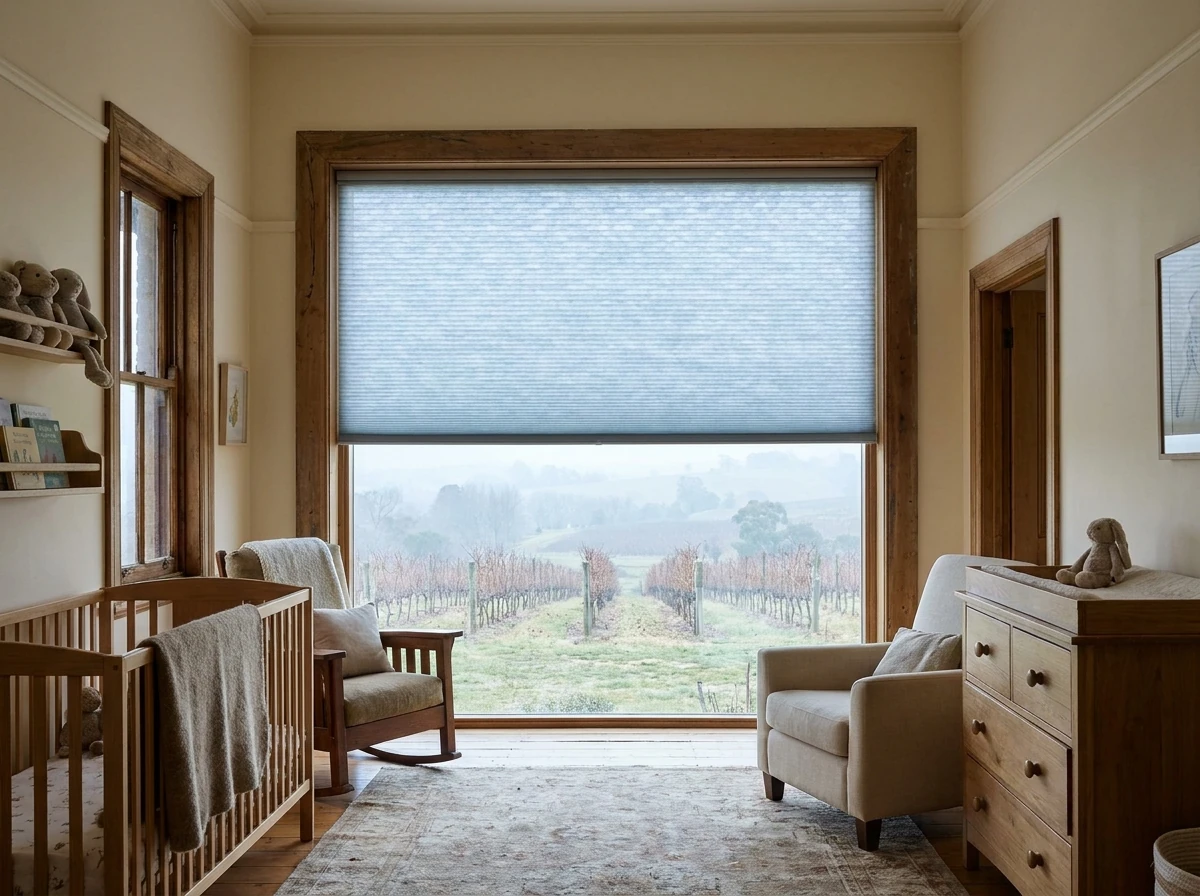
Thick lime-plastered walls and small original window openings do a good job of keeping a Wellington farmhouse cool through a hot, dry summer. The trade-off shows up in winter: those same walls, plus glass that was never specified with insulation in mind, let a room lose heat quickly once the valley's cold, wet nights set in — and with snow visible on the Groenberg and Hawequas some seasons, that cold is not a mild one. A cellular honeycomb blind's hexagonal air cells trap a still layer of air directly against the glass, working as a soft thermal buffer in both directions.
Where it earns its keep fastest
Bedrooms and nurseries in older farmhouse wings, guest cottages on wine estates that stand empty through the week and need to warm up fast, and any room where the household has already noticed "that one always feels colder" — cellular blinds are usually the first thing worth trying before a bigger heating fix. The trapped cells also take a little of the edge off sound, which matters on function-room additions near a working cellar.
Top-down/bottom-up, for a street- or werf-facing window
Where privacy from a farm road or a neighbouring werf building matters as much as light, a top-down/bottom-up cellular blind lets the top of the window stay clear for daylight and mountain view while the bottom stays covered — a genuinely different control layout to a roller or venetian, and one that suits Wellington's mix of working farmyards and residential windows sitting closer together than a typical suburban street.
The rooms we get called back to fit cellular blinds in are almost never the ones that are too hot — they're the ones that are surprisingly, stubbornly cold.
On-site measure, WellingtonWhat a cellular blind costs
A guide per square metre, installed. Manual cellular blinds run R1,500 to R2,800 per square metre, and the spread inside that is wider than most people expect: a single-cell light-filtering fabric sits at the bottom, a double-cell blockout with side channels at the top. On a thick-walled room that loses its heat overnight in July, the double cell is the specification that actually changes how the room feels.
Motorised, the range is R3,000 to R4,800 per square metre — often the right call where a cellular blind has been specified for high or awkward glass. Small openings carry a minimum charge, and the exact figure for each window is written into the quote after the free measure, before anything is ordered.
- Light-filtering or blockout cell fabric
- Top-down/bottom-up operation for werf- or road-facing windows
- Cordless or motorised control, no dangling loop
- Slimmest stack of any blind when fully raised
- Shaped and skylight versions on request for gable glazing
Got a room that's always the cold one?
We measure at the house for free, quote in writing per opening, and leave you to decide.